Art Club Safely Returns to The Brook Inn

The Brook Inn

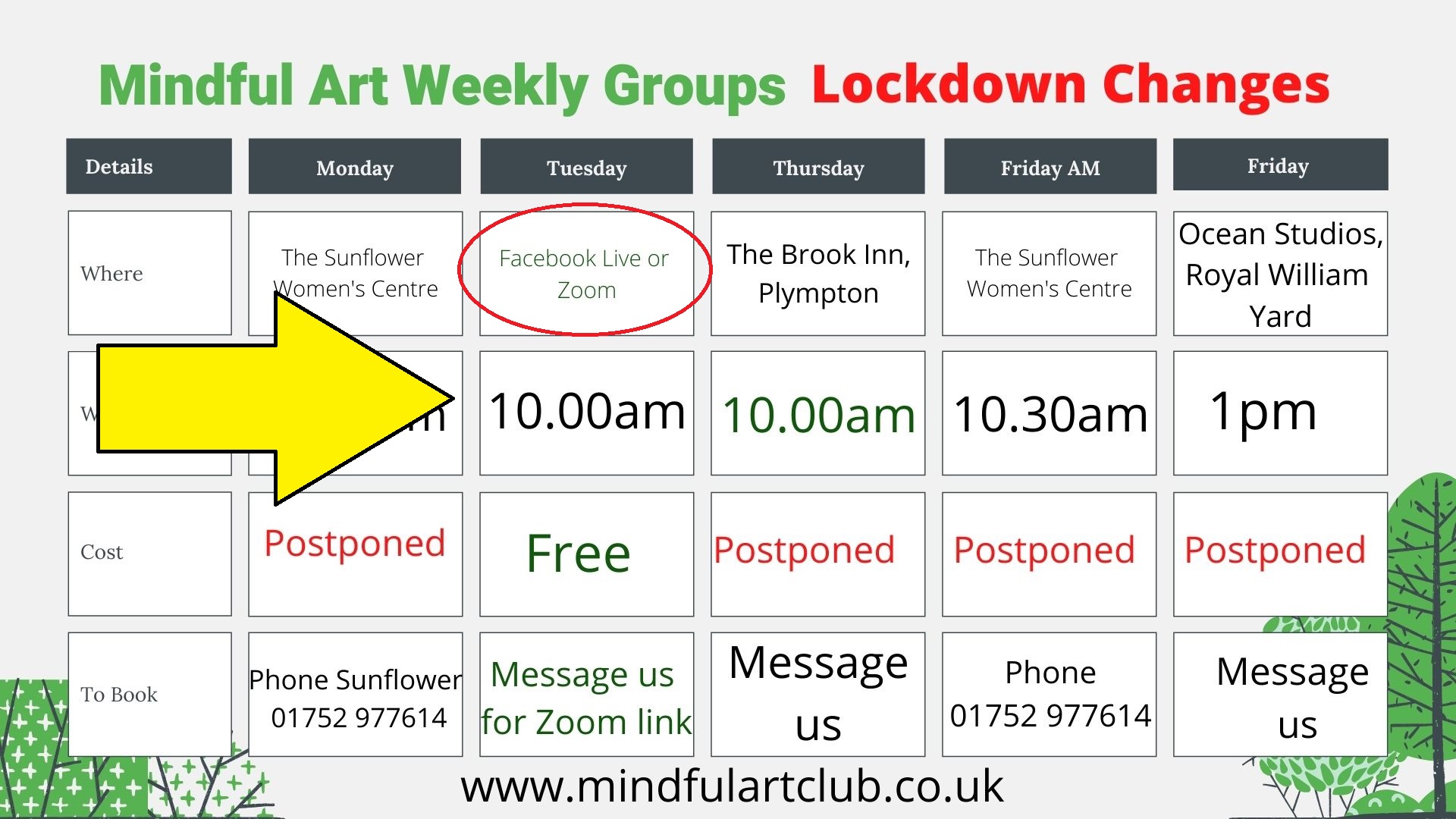
Mindful Art Club are looking forward to returning to our old venue, The Brook Inn, Longbrook Street in Plympton, as of 10am on Thursday 17th September.

The new six person rules – which come into force on 14th September – are a change to England’s current guidance. But regular Brook Inn customers will know that landlord John Govier, and his team, have been following all the government guidelines since they re-opened, so this won’t make any difference to how they operate, when it comes in to force from Monday.

At-a-glance: How do the new rules affect mindful art classes?

  • Social gatherings of more than six people in England will not be allowed in law from Monday 14 September.
  • The new rule applies to pubs, cafes and public outdoor spaces.
  • However, gatherings can be more than six if it is for education purposes.
  • Support groups can take place in gatherings of any number if the support group is organised by a business or a benevolent institution to provide mutual aid.
  • Our mindful art classes at The Sunflower Women’s Centre will be run in groups of six, and booking for these is essential. (Phone 01752 977614 to go on the waiting list.)
  • Pubs and restaurants are still allowed to have more than six customers inside, but the groups of six have to be socially distant from each other.
  • Mindful art club tends to be around six to eight people. There is plenty of space for us to all sit on separate tables, safely distanced from one another.
  • The Brook Inn follows all safety and hygiene measures set out by the government, and always has done since reopening in July.

For Your Peace of Mind

At The Brook Inn and The Sunflower Women’s Centre we check temperatures on arrival, and take client details for track and trace. Paper and felt tip pens are provided, but you can also bring your own felt tip pens to reduce the risks of sharing pens.

If you have any questions or concerns about coming to Mindful Art Club during the current pandemic crisis please contact us.

You may also like to try a free, online class .

Mindful Art Club will be at The Brook Inn every Thursday from 10 am until 11.30am.

10 Reasons to Celebrate (Despite Covid-19)

Last week Emma and Peggy held a Mindful Art Club committee meeting with two of their volunteers, (in Peggy’s backyard!) and made a note of all the things we have managed to achieve since our last committee meeting, in January 2020.

  1. We set up weekly Zoom meetings and hosted them throughout the coronavirus lockdown, and beyond.
  2. We held a staff wellbeing session on Zoom for ColebrookSW support services.
  3. Peggy’s counselling course was moved onto Zoom. She continued to attend classes, and gained her Level 3 qualification.
  4. We wrote a Mindful Art Activities eBook, to go on sale next month.
  5. We wrote an 8-week Mindful Art Wellbeing Course, which we will be testing out with a small group during September.
  6. Our volunteer, Lee, has learned to play the tongue drum, providing relaxing sounds at our outdoor mindfulness groups.
  7. We hosted four, small, socially-distant, outdoor, one-day retreats.
  8. After lockdown eased, we started a weekly art group at The Sunflower Women’s Centre, in their beautiful, outside courtyard.
  9. We have held small, weekly outdoor groups in Plympton all summer.
  10. Our loyal clients have continued to support us throughout this pandemic by turning up to our online groups, and outdoor groups, and contributing donations to our running costs.

How to Celebrate When We Can’t Even Have a Party

We are so grateful that we have been able to do all of these things, and keep mindful art club going, despite the global pandemic. On 10th September it will be one year since we held our first mindful art group at The Brook Inn, Plympton. We’d love to hold a big event to celebrate, but we’ll have to be content with a small, outdoor meal to celebrate Mindful Art Club’s first anniversary.

We will be able to celebrate in a virtual way at our online art group on 15th September, and we would like to reward our loyal clients with a small gift, which will be sent out to our mailing list on our ‘birthday’, 10th September.

Get on the list!

Don’t miss out, join our mailing list here, and get free mindful colouring pages, and news about our upcoming free and low-cost events.

Subscribe

* indicates required

One-Off Art Club in Torpoint

The Mindful Art Club are heading to Awenek Studio to host one of our art for wellbeing sessions. This event is free, and there are two parts to the session with options to bring your own packed lunch or just come to the morning or afternoon. Please get in touch with awenekstudio@gmail.com
or text 07931457386 to confirm your space.

THURSDAY, 10 SEPTEMBER 2020 FROM 10:30-14:00


They have an indoor outdoor socially distanced space but are keeping numbers to five participants morning/afternoon. The Studio is based at Maker Heights, a beautiful and picturesque hilltop location that serves the communities of Millbrook, Kingsand, Cawsand and Cremyll. 

Awenek Studio CIC is a hub for all those artistic people or anyone who wants to have a go at the joy of being creative together.

More info on Facebook: Mindful Art Club at Awenek Studio.

[Photos] Mindful Art at the Beach

Do you struggle to pay attention to the present moment?

Does your mind wander when you’re at a mindfulness class?

Are you avoiding indoor public places because of Covid-19 risks?

Outdoor mindfulness could be the answer you are looking for!

Before March 2020 we were comfortable running our mindful art groups in cosy pubs, cafes and community venues around Plympton and Plymouth. However, after lockdown restrictions were eased this summer, we started running small outdoor groups, and discovered this adds an extra dimension of fun to mindful art club.

A review of scientific research has indicated that the mental and physical benefits of practicing mindfulness in nature may be considerable. (Mindful.org March 2020)

You won’t be surprised to learn that being in nature boosts our health and well-being, and that combining the outdoors with mindfulness can lead to even better results.

As the Autumn weather approaches we are going to have to take our regular groups indoors, bearing in mind Covid-19 safety guidance, such as social distancing and limits on numbers. But keep an eye on our Facebook page because if the weather forecast is good, we may be able to take some spontaneous trips outside, like this small group we held on Wembury beach recently.

Don’t miss our next event. Follow our Facebook page and join our Facebook group.

How to Reduce Stress and Increase Confidence

Want to improve your mental health, make new social connections and learn some fun new ways to cope with stress?

It could be time to try Mindful Art Club!

Some of the issues being tackled in our community mindful art groups are social isolation and poor mental health. We address these problems by using creative activities to make it easier for clients to engage in meaningful conversations. Often when depressed or anxious people are put in a position where they have to talk about how they feel, it’s the last thing that they want to do. In our art groups they have a place where there is something slow and steady to do, and there is no pressure to talk about anything. We find in our groups that as people begin to trust each other, they open up about how they feel and get support and identification from the rest of the group.

Two of the most common mental health issues are anxiety and depression. Research shows that the activities of mindfulness and art can be more effective than antidepressants and counselling. Author of ‘Lost Connections’, Johann Hari, believes that to help people change their lives they have to have a connection with other people, to find meaning and purpose.

Being in a supportive group builds up self-esteem and confidence. We do a different art project each week, and trying new activities has been proven to be good for our wellbeing and emotions, (in a survey by BBC Arts 2018). The same survey said that nothing beats taking part in art classes that involve face to face social interaction for people’s mental health.

So, our community groups give people the opportunity to share their feelings, practice mindfulness, create art, relax and chat. Mindful art club:

  • 1) Improves mental health
  • 2) Improves social connection
  • 3) Teaches new skills.

Try mindful art club for free by checking out our online group.

How Art Can Help You Cope

Even a small amount of creativity can help you to cope with modern life, according to recent research by BBC Arts and UCL. In the largest study of its kind, with almost 50,000 people taking part, the research explored for the first time how creative activities can help us manage our mood and boost wellbeing. (Creativity Can Help You Cope – BBC, accessed 10/08/20)

The Evidence

A Health Evidence Network (HEN) synthesis report on arts and health references over 900 publications, including 200 reviews, covering over 3000 further studies.

Arts interventions, such as singing in a choir to improve chronic obstructive pulmonary disease, are considered non-invasive, low-risk treatment options and are increasingly being used by Member States to supplement more traditional biomedical treatments.

The Health Evidence Network synthesis report

What is the evidence on the role of the arts in improving health and well-being?

In July 2017 the All Party Parliamentary Group on Arts, Health and Wellbeing published a report of their two-year inquiry into the role of the arts in health and wellbeing.

It found that the arts can keep us well, help us recover, and help to meet some of the major challenges currently facing health and social care. Therefore the arts can help to save money in the health service and social care services. You can read the short report here:

Creative Health: The Arts for Health and Wellbeing

But How Do We Know That Mindful Art Club Works?

People who come to Mindful Art Club feel more supported, experience empathy, feel mentally calmer and more peaceful; they make new social connections and feel happier and more confident. They also learn to use mindfulness as a self-help tool, and learn to use art as a self-care activity.

We know these things because we get verbal feedback during the “check out” at the end of each session, and occasionally we ask our clients to complete written feedback forms. These simple questionnaires measure the client’s perception of their difficulties, including mental health, physical health, loneliness, self-esteem, and experience of art and mindfulness. We also gather some qualitative evidence, in the form of individual case studies.

Find out more by coming to an online group, or a community group in Plymouth. The online groups are free.

New: One Day Retreats

We have started to host small, socially distanced, outdoor retreats. Join us for a day of laughter, conversation, mindfulness and art, surrounded by the peacefulness of nature. If you enjoy our weekly mindful art groups you will love our full day of relaxing activities.

  • Guided mindfulness with Emma
  • Qi Gong with Lee
  • Simple art activities with Peggy
  • Nature walk with everyone!
  • Lunch, tea, coffee and cake included

Read more: Mindful Art Retreats

[Video] How to Draw a Mandala

Emma's mandala
  • What are the benefits of drawing a mandala?
  • What are the spiritual origins of mandalas?
  • What can mandalas symbolise or represent?

Find out now, in this video micro-lesson, with Peggy and Emma.

In this short excerpt from a Mindful Art Club Zoom session, we draw mandalas using household objects, and show you some examples of both simple designs, and complicated designs, for inspiration.

You can share your mandala with us at www.facebook.com/mindfulartclub

Now we’d love to hear from you. What would you like to see Mindful Art Club do next? Visit www.tinyurl.com/mac-feedback to tick off the things that you like, on an easy checklist.

Our Zoom sessions are free to join every Monday at 10.00am. Send us a message if you would like the meeting link. Alternatively, watch the live sessions as a Facebook live video, as the Zoom session will be live broadcast to our Facebook page. You can join in with the guided mindfulness, and join our discussion by writing in the comments below the video live stream.

Science: Does Mindfulness Work?

I have just completed my studies at Level 3 in counselling. During the course we had to write an assignment about an area of research that interested us. I thought I would share an excerpt here.

Peggy

Explain why research findings are important in counselling work

At the moment, I am particularly interested in looking at research into the use of mindfulness in counselling. Mindfulness is the practice of focusing on the present moment, without judgement. During my level three counselling training we often began the day’s learning with a group mindfulness session. With my business partner, Emma, I run a community support group called Mindful Art Club, which offers a “check in”, some guided mindfulness, and mindful drawing practice. We then encourage the group to do a simple art project that requires no talent or experience. Members chat informally about their current thoughts and feelings. We then end the group with a “check out”.

When we seek charitable funding to run these groups we have offered both quantitative and qualitative research findings to the funders. We have surveyed our membership, using two client evaluation tools; the PHQ-9 Depression and GAD-7 Anxiety questionnaires. We have also done a few in-depth case studies of individuals, during which the clients described their experiences in their own written words. However, this is a very small data sample; so scientific research papers, with a large data sample size, demonstrating the efficacy of mindfulness would also be helpful to us. A search on the BACP website offers over 300 articles related to mindfulness. I found an interesting article that says mindfulness can be helpful regardless of a client’s presenting problem. (Kamila Hortynska 2014). To back up her article she references 20 different sources including books, websites, professional journals, research papers and NICE guidelines.

Using this as a starting point for my investigation, I can see that there is an abundance of research available related to mindfulness in counselling. From Hortynska’s article we can learn that research has resulted in mindfulness being approved by NICE, and is now used in schools, for corporate employees, for the treatment of depression, was offered as taster sessions in parliament, and is now offered in some statutory services, thanks to a research project at the Centre for Mindfulness Research and Practice at Bangor University. (Bangor University 2014). Their website refers to research papers describing a randomized control trial of stress reduction in the workplace, and the initial results from a study of the effects of meditation on multitasking performance. Research papers like these would help us to explain to a corporation the potential value of commissioning a mindfulness course for stress reduction in their workplace.

Research findings provide useful and valuable evidence of the efficiency of various new and existing counselling theories and methods, which can benefit and inform counsellors, clients, funders, companies, agencies, charities, health services, policy makers and government organisations.

References.

  1. Hortynska, Kamila (2014) Being With What Is, Private Practice, Winter 2014, (accessed 12/06/2020.) https://www.bacp.co.uk/bacp-journals/private-practice/winter-2014/being-with-what-is/
  2. Bangor University, Mindfulness in the Workplace. www.bangor.ac.uk/mindfulness/work.php.en (accessed 12/06/2020).

Enjoy this blog? Please spread the word :)

Follow by Email
YouTube
YouTube
LinkedIn
INSTAGRAM